
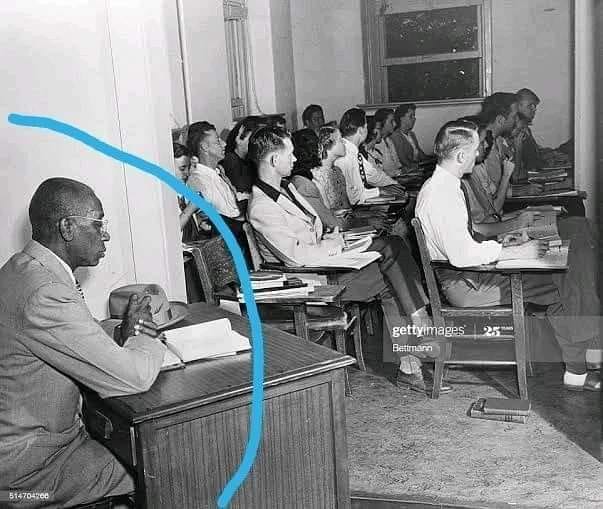
In the hallowed halls of the University of Oklahoma, 1948, a man named George W. McLaurin walked a path few had dared to tread. As the first Black man admitted to the university, he was a pioneer, a beacon of hope in a world shrouded in prejudice. Yet, his journey was far from easy. Forced to sit in a corner of the classroom, isolated from his white peers, McLaurin faced a silent storm of discrimination. His presence was a challenge to the status quo, a reminder of the deep-seated inequalities that plagued society.
Despite the cold stares and the deafening silence, McLaurin’s spirit remained unbroken. His name, etched in the annals of the university’s history, stands as a testament to his resilience and determination. Among the top three students of his class, he proved that excellence knows no color. His words, a reflection of his struggle and triumph, resonate through time: “Some colleagues looked at me as if I were an animal, no one spoke to me, the professors seemed indifferent, not even answering my questions. But I dedicated myself so much that eventually, they began to seek me out for explanations and to clarify their doubts.”
McLaurin’s story is a powerful reminder that education is the greatest weapon we possess. It has the power to break down barriers, to challenge prejudices, and to transform the world. His legacy is not just one of academic achievement, but of courage, perseverance, and the unyielding belief in the power of knowledge. Through his journey, we are reminded that the pursuit of education is not just a personal endeavor, but a collective one, capable of shaping a more just and equitable society.
© Beatriz Esmer
 Beatriz Esmer