
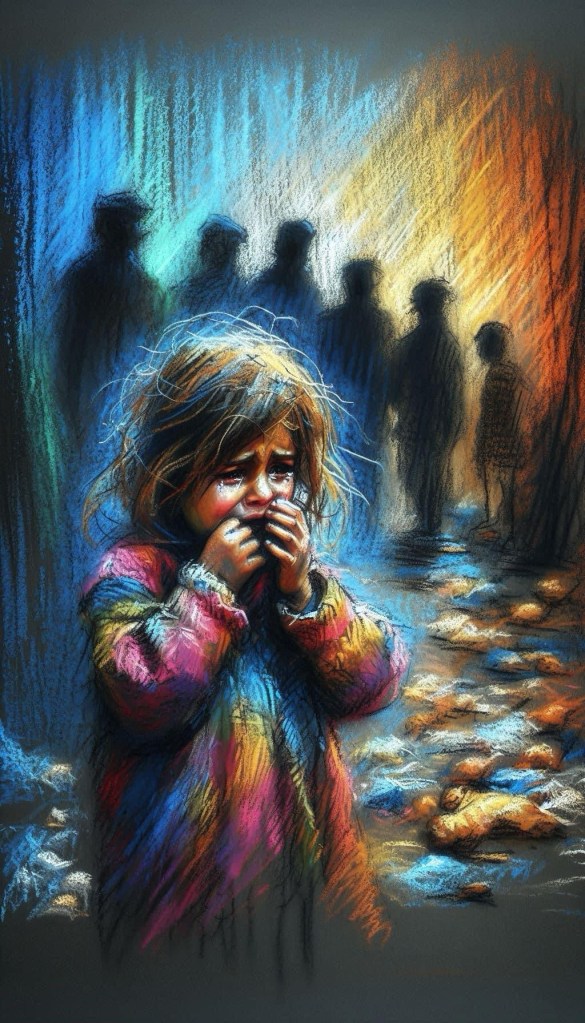
“The crowd outside continued shouting furiously, but suddenly their cries became lamentations and tears, I’m blind, I’m blind, they were all saying and asking, Where is the door, there was a door here and now it’s gone.” In this haunting moment from Saramago, we are confronted with a profound truth: our suffering is an intrinsic part of our existence, a vicious cycle that we both inflict and endure. If there is a god, then at least there is someone other than humanity to blame for our unspeakable suffering—a suffering we experience precisely because we impose it on ourselves and others.
We are oppressors and victims both, trapped in a system that Christian theodicy insists is just, claiming our suffering is the price for the oppression we commit. Yet, only a cruel deity would insist on this endless cycle. Saramago’s vision rejects any notion of just punishment, loathing the god who intertwines justice with violence. In his eyes, this god is an embodiment of banal evil, a reflection of humans wielding power thoughtlessly, incapable of contemplating the true consequences of their decrees.
For Saramago, this fictional god represents the callousness of all those in power, afflicted as they may be, who try to deflect their own pain onto others. It mirrors a deeper, unsettling truth—that those who govern and wield influence, much like Herod in The Gospel According to Jesus Christ, perpetuate a structure of suffering, an eternal diversion of affliction.
Once, I held a deep love for humanity, but now, that love has been eroded by hopelessness. The relentless cruelty, the ceaseless suffering, the thoughtless perpetuation of pain—it all chips away at the foundations of my faith in the human spirit. And yet, in recognizing this despair, there lies a glimmer of understanding, a painful clarity about the nature of our existence and the power structures that govern it. Perhaps, in this acknowledgment, there is a seed of hope, the beginning of a new, more compassionate understanding of what it means to be human. ❤️
©️ Beatriz Esmer
 Beatriz Esmer
Being human is always changing and immensely complex. Many philosophies have tried to work it out and none can fill the void completely. One thing most say is that midfully contempating a much bigger purpose or vison and being minful of our finite nature is key. In this I can’t argue, knowing that we and all around us are finite would surely bring a better humanity.