
Anesthesia looks like it will not pass, it is hard to awaken after this great defeat of…
First, let me try to explain what are the meanings of football to me and millions of Brazilians: Football permeates daily life and the imaginary of all Brazilian people in general, even those who do not appreciate and do not follow it. It is present even in colloquial language in everyday expressions as “embolou o meio de campo — Pack the midfield” (it means a mess), “she was laid to the corner colocou — fulana para escanteio ” (she was slighted), “he is from the penalty spot — sicrano está na marca do pênalti” (it means he is almost there to get something). Football is a passion, it loves the shirt of our team, and it is the promise to thousands children get out of the poverty for a better future, it represents joy, it is a dream…
Music and Football: Almost a symbiosis
Ever in popular music, the dialogues are more fruitful. From Noel Rosa up to group Skank (rock band from Minas Gerais State), passing by Jorge Ben, Chico Buarque, João Bosco and Gilberto Gil. Football is the motto and inspiration from a rich repertoire. There is almost a symbiosis between the rhythm of the music and the football cadence. It is widespread throughout the world the cliché according to which the Brazilian, who plays football, usually loves the samba. “It’s good in the samba, it is good in the leather (an analogy to the ball that is made of leather),” it says the lyrics from the song “The world cup is ours, Wagner Maugeri, Lauro Müller, Maugeri Nephew and Victor Dago”, composed for the celebrations after the Brazilian Football Team had won the FIFA World Cup 1958 in Sweden.
The idea of a swing, a “the way how to rock the waist” that characterize the Brazilian and that would be present in samba, Capoeira and football, it is one of the central issues in discussions about Brazilian cultural identity that took place since the Thirties from the century past.
Brazilian Social Thought
The sociologist Gilberto Freyre, in line with the research of journalist Mario Filho (brother of Nelson Rodrigues, journalist and writer) about “the black people in Brazilian football,” developed the thesis that ethnic and cultural miscegenation in Brazil generated a distinctive and unique way of the absorption coming culture of Europe and Africa. In the specific case of football, the Brazilians have “softened” the game, changing the posture so gross and martial from Europeans for more sinuous and sensual style, closer to dance than war.
The Brazilian football, so this was a fundamental part of Freyre’s argument in defense of miscegenation as distinctive — and positive — of our formation and our contribution to the world. This fruitful idea, although today much discussed and eventually qualified as mystifying, marked a whole strand of Brazilian social thought, from Freyre and Antonio Risério and through Darcy Ribeiro.
It is very difficult for other people to understand how we are so passionate about football, it is necessary to delve into our culture and live our everyday experiences, our disappointments down over time and emerge back into our passions, social and cultural adversity.
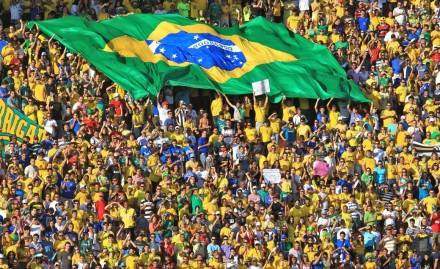
Today I am grieving because I feel a deep sadness. I believe that all Brazilians needed of this victory, the joy of seeing Brazil beating Germany or getting to the grand finale, despite all the political mistakes relating to the organization of the World Cup, corruption, etc. We Brazilians are weary about so many defeats, in education, in health, in security, in life, in politics, etc. We are happy by nature and we need that flame that warms us up: Bliss! ❤
 Beatriz Esmer
Hi Bia, I will write in German:
Für mich persönlich waren folgende Beobachtungen von Bedeutung: Brasilien gilt als Land des Fußballs, ein Land, in dem Fußball eine außerordentliche, ja überragende Bedeutung im persönlichen und gesellschaftlichen Leben genießt. Der Bericht über die Geschichte des Maracana, von dem ich bereits gesprochen hatte, hat das auch sehr schön herausgearbeitet. Dass Brasilien also Ort ein Weltmeisterschaft ist, ist deshalb nichts ungewöhnliches.
Erstaunt hatte mich aber, in welchem Ausmaße wegen der politischen Versäumnisse in Sachen Bildung, Gesundheit, Transport, …… es derart massiven und grundlegenden Widerspruch gegen die Austragung der Spiele in Brasilien gegeben hatte. Hier scheint sich für mich ein modernes brasilianisches Selbstverständnis herauszubilden, das elementare humane Bedürfnisse und deren Anerkennung vor ein “Wir-Fußball – Gefühl” stellt. Also den einzelnen Bürger mit seinen individuellen Ansprüchen an die Gesellschaft in den Mittelpunkt stellt.
Die Bilder aus dem Publikum im Stadion beim gestrigen Spiel wiederum haben mir in ihrer Trauer, in ihrer Verzweiflung sowie ihrer übergroßen Erwartung und der schließlich brutalen Abwendung von der Mannschaft genau gezeigt, wie sich diese beiden Ebenen überlagern und vermischen.
Wenn ich es richtig verstehe, sind wesentliche Elemente brasilianischer Identität – um es zu pointieren- entstanden aus Samba, Karneval und Fußball während des letzten Jahrhunderts, die eine kulturelle und ethnische Besonderheit, ja Einzigartigkeit Brasiliens betont haben.
Brasilien als sogenanntes Schwellenland wird seine Identität sicher weiterentwickeln (müssen) in den nächsten Jahrzehnten. Schon das Maracana als Ausdruck modernster und kühnster Ingenieurskunst oder später der Bau von Brasilia waren ja Schritte, Brasilien als ein modernes, demokratisches und entwickeltes Land darzustellen – also Identität zu gewinnen aus der Bewältigung der Gegenwart. Diese Moderne wird einen Niedergang von klassischem Nationalismus bedeuten (müssen).
Sehr gut verstehe ich, dass ein Gefühl von vielen, vielen Niederlagen im Leben eine übergroße Erwartung an den Fußballs stellt, die dieser naturgemäß nicht immer und nicht oft erfüllen kann.
Ich bin gespannt, welche Konsequenzen ihr Brasilianer aus der Niederlage ziehen werdet.
1954 war der Gewinn der Weltmeisterschaft für Deutschland nach dem Zweiten Weltkrieg sehr elementar. 1950 noch war Deutschland bei der Weltmeisterschaft in Brasilien nicht zugelassen. Das Endspiel und der Titel 1954 sind noch heute legendär – mittlerweile ist auch ein Spielfilm dazu produziert worden. Fußball hat damals sehr wesentlich zum Aufbau- und Integrationswillen Deutschlands (“Wir sind wieder wer”) beigetragen – er war ein positiver Stimulus, der kulturell mit den Aufbauleistungen im sogenannten Wirtschaftswunder zusammenfiel.
Bei Euch ist es 2014 eine bittere Niederlage – im Umkehrschluss zu 1954 und mit Blick auf das heutige Brasilien verstehe ich die große Trauer, die Euch befallen hat. Die spannende Frage für mich ist, was Ihr Brasilianer daraus macht: “Nach dem Spiel ist vor dem Spiel.”
Alles Gute auf dem Weg, Bia.
Vielen Dank! Ich schätze Ihre Kommentare. 😉